UN’s “Global Compact” — A Framework for Responsible and Sustainable Business
2025-12-02The United Nations Global Compact (UNGC) is the world’s largest corporate sustainability initiative, launched in 2000 by the UN to encourage companies worldwide to align their strategies and operations with universal principles on human rights, labour, environment, and anti-corruption. Today, more than 20,000 companies and organizations across 160+ countries participate in the initiative, making it a global movement for responsible business.1
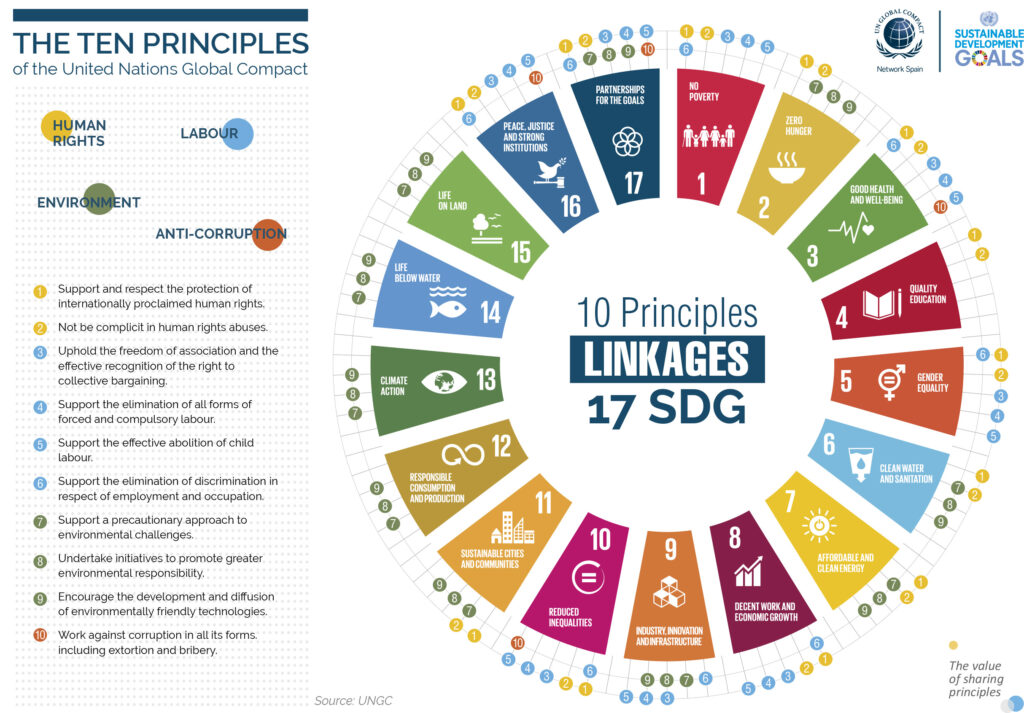
At its core, the Global Compact is built around Ten Principles, derived from internationally recognized standards such as the Universal Declaration of Human Rights, ILO Core Conventions, the Rio Declaration on Environment and Development, and the UN Convention Against Corruption. These principles offer a universal framework to help businesses integrate sustainability, transparency, and ethical conduct into every dimension of their work.
Why the UN Global Compact Matters
The Global Compact emerged from the increasing recognition that sustainable development requires active leadership from the private sector. Governments alone cannot address global challenges such as climate change, inequality, environmental degradation, and corruption. Businesses — especially those operating across sectors and borders — play a critical role in shaping economic, social, and environmental outcomes.
By joining the initiative and committing to the Ten Principles, companies signal that they are ready to align their economic activity with shared global values, contribute to the Sustainable Development Goals (SDGs), and adopt long-term strategies that prioritize people, planet, and prosperity.
How the Global Compact Benefits Key Stakeholders
- Governments: It strengthens national and international governance frameworks by encouraging businesses to adopt responsible practices aligned with public policy goals.
- Businesses: For companies like SAME-SSP, the Global Compact serves as a strategic platform. It improves access to global best practices, enhances credibility with investors and partners, and supports innovation in sustainable solutions across clean energy, agro-food, water, fintech, health, and education. Participation also helps firms manage ESG risks and improve long-term competitiveness.
- Civil society and NGOs: The Global Compact enables collaboration, accountability, and impact measurement. It creates space for constructive dialogue between the private sector and society.
- Consumers: It enhances trust and transparency by assuring that participating companies commit to fair labour practices, environmental stewardship, ethical governance, and respect for human rights.
- Future generations and the environment: By encouraging responsible production, green innovation, and the protection of ecosystems, the Global Compact contributes to a more resilient and sustainable global economy.
How SAME-SSP Can Leverage the Global Compact
Given SAME-SSP’s multi-sectoral identity and commitment to sustainable, inclusive solutions, the Global Compact offers a powerful framework for aligning business operations with universally accepted principles. Through the initiative, SAME-SSP can:
- Integrate responsible business standards into all solution areas — including energy, agro-food, water, health, education, and digital finance;
- Strengthen transparency, governance, and stakeholder trust through credible global norms;
- Position projects and partnerships in line with the SDGs, enhancing cross-border collaboration and funding opportunities;
- Access international networks, training programs, and innovation platforms that support sustainable business transformation;
- Demonstrate a clear commitment to ethical, environmental, and socially responsible growth.
By embracing the UN Global Compact, SAME-SSP reinforces its central mission: delivering smart solutions through strategic partnerships that create lasting value for communities, the economy, and the planet.
Footnote
- United Nations Global Compact (2023). UN Global Compact Annual Report 2023. New York: United Nations. ↩︎