“Systems Thinking” at SAME-SSP
2025-12-05A Strategic Framework for Designing Smart, Sustainable and Resilient Solutions
At SAME-SSP, Systems Thinking (ST) is one of the core analytical foundations that guides how we design strategies, develop projects, build partnerships and deliver impact. Operating in sectors such as Clean Agro-Food & Water, Clean Energy, Health, FinTech and Education (Skills Transformation) requires navigating environments that are dynamic, uncertain and interconnected. Systems Thinking provides the conceptual and methodological tools to understand these complex environments and respond effectively.
What Systems Thinking Means for SAME-SSP
In ST, a system is understood as a set of interdependent components whose interactions —through feedback loops, accumulations (stocks), flows, delays and nonlinear effects— create patterns of behavior over time. According to Sterman, system behavior is determined not by isolated events but by underlying structures.
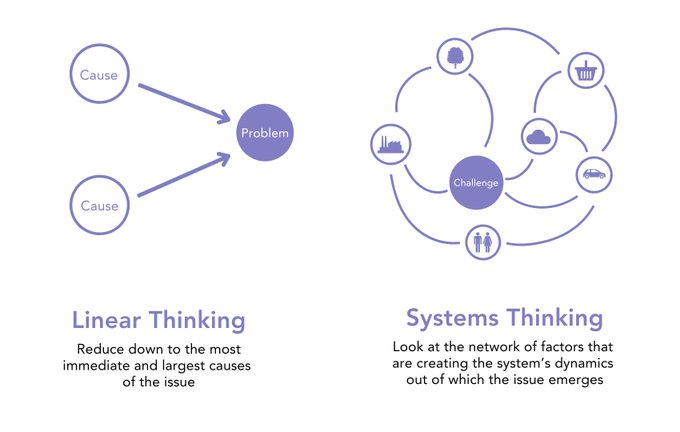
For SAME-SSP, this principle means:
- We focus on long-term patterns, not short-term events.
- We analyze system structure, not symptoms.
- We design interventions that produce scalable and sustainable impact.
- We anticipate unintended consequences, preventing costly policy or project failures.
Why Systems Thinking is Critical for SAME-SSP’s Mission
Across all SAME-SSP service domains, decision environments exhibit volatility, uncertainty, complexity and ambiguity (VUCA). ST helps us transform these challenges into strategic advantages:
1. Clean Agro-Food & Water
Food systems, water cycles and agricultural productivity depend on interacting ecological, climatic, economic and social variables. ST enables SAME-SSP to design resilient water-food solutions rooted in whole-system understanding.
2. Clean Energy
Energy transitions involve balancing supply–demand dynamics, investment cycles, climate risks, technological change and policy incentives. ST provides insight into long-term energy pathways and avoids short-term, counterproductive decisions.
3. Health
Health ecosystems are nonlinear systems characterized by feedback loops, resource constraints, and time delays. ST helps optimize service delivery, manage risks and improve population-level outcomes.
4. FinTech
Financial systems are highly interconnected networks where small changes can produce systemic ripple effects. ST guides responsible innovation, risk mitigation and sustainable digital financial inclusion.
5. Education
Education outcomes emerge from complex relationships among skills, institutions, technology and socio-economic context. ST helps design scalable, inclusive and adaptive learning strategies.
How SAME-SSP Uses Systems Thinking in Practice
Systems Thinking shapes our strategic and operational methodologies:
- Problem definition through dynamic patterns (reference modes)
- Causal Loop Diagrams (CLDs) to identify reinforcing and balancing forces
- Stock-and-Flow modeling to understand accumulations and long-term dynamics
- Scenario simulations to test policies and strategic options
- Identification of leverage points (Meadows, 1999) for high-impact interventions
- Integration with SDGs, UN Global Compact, ESG & ESG Ratings for coherent, sustainability-aligned decisions
This approach enhances SAME-SSP’s ability to design Smart Strategic Partnerships (SSP), manage VUCA environments, and generate resilient and measurable value.
Why ST Matters for SAME-SSP’s Future
Systems Thinking enables SAME-SSP to:
- anticipate emerging trends rather than react to them,
- design projects that remain robust under uncertainty,
- understand cross-sector interactions across its five service domains,
- align actions with global sustainability frameworks (SDGs, Global Compact, ESG),
- ensure that solutions are not only effective but also scalable, responsible and future-proof.
In short:
Systems Thinking is not just a methodology for SAME-SSP; it is a strategic lens that strengthens our capacity to deliver smart, sustainable and resilient solutions in a complex world.